15/12/2025
Sabancı University, in collaboration with Sabancı Business School and the Journal of Business Ethics (JBE), one of the world's leading academic journals, hosted an Article Development Workshop and Writing Camp on December 12-13, 2025. The two-day workshop, held at Sabancı Business School, included presentations, sessions, and interactive workshops focusing on academic writing and publishing processes in areas such as business ethics, sustainability, corporate social responsibility, and human rights.

The program, organized with the direct participation of JBE editors, aimed not only to equip academics with technical writing skills but also to provide in-depth feedback on how to build a stronger and more consistent ethical framework for their research. Throughout the workshop, participants had the opportunity to evaluate the publication journey of their articles, from the design phase to the peer review process, from the perspective of the editors.

Speaking at the opening of the first day's session of the workshop, Gazi Islam (Grenoble École de Management), one of the editors-in-chief of JBE, positioned business ethics research within today's multifaceted crisis environment. Stating that increasing inequalities, the climate crisis, technological transformation, and corporate vulnerabilities necessitate a rethinking of the meaning of academic production, Islam defined JBE's mission as "creating a pluralistic space for discussion that contributes to making the world a more livable, just, and ethical place." He further stated that the journal aims to move beyond Western-centric academic production patterns, opening up more space for diverse intellectual traditions and experiences.

Another editor who spoke at the workshop, Masoud Shadnam (Sharif University of Technology), addressed the academic writing process through the concepts of personal intellectual journeys and persistence. Sharing examples from her own publishing experiences, Shadnam stated that it can sometimes take years for an idea to mature and find the right journal, saying, “Rejecting an article multiple times doesn’t mean it’s worthless. Academic production should be seen as a learning process, allowing the idea to find its place over time.” Shadnam also emphasized that ethical research should not be confined to a single cultural or geographical center, noting that studies from diverse contexts enrich the literature on business ethics.
Speaking at the event, JBE editor Fida Afiouni emphasized that, especially in articles submitted to the field of business ethics, the ethical dimension should be central to the research, not an afterthought. Recalling her role as an associate editor in the Human Resources Management and Human Resources Development section, Afiouni stated, “Even an article from the Human Resources (HR) field is not suitable for JBE if it doesn’t present a clear and consistent ethical analysis. If the article wasn’t designed around an ethical question from the outset, it’s extremely difficult to transform it into an ethics article later.” Afiouni also stressed that rethinking classic HR topics such as performance, compensation, and evaluation through the lenses of justice, power relations, and normative ethics could produce powerful contributions to the field.
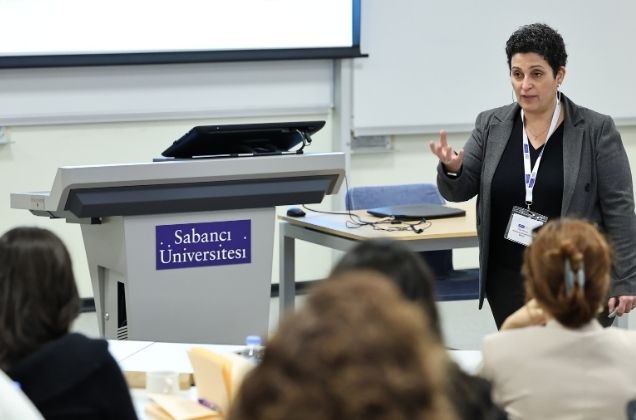
In the afternoon, participants presented their articles on business ethics to JBE editors in three parallel sessions. They benefited from detailed feedback from the editors and other participants. On the second day of the event, participants met again with editors in roundtable sessions to refine their work based on the feedback received on the first day. By applying this feedback to their articles, they worked on clearer and more powerful academic narratives that advanced research in the field of business ethics.
This Article Development Workshop, held at Sabancı University, not only offered academics publication strategies but also provided a broader intellectual framework on why and how research should be conducted in the field of business ethics. Bringing together academic researchers from 25 different national and international business schools, the event once again demonstrated Sabancı University's commitment to hosting international academic discussions centered on ethics, sustainability, and social responsibility.