15/02/2026
The percentage of women on the boards of directors of companies listed on the Istanbul Stock Exchange (BIST) has risen to 19.4%
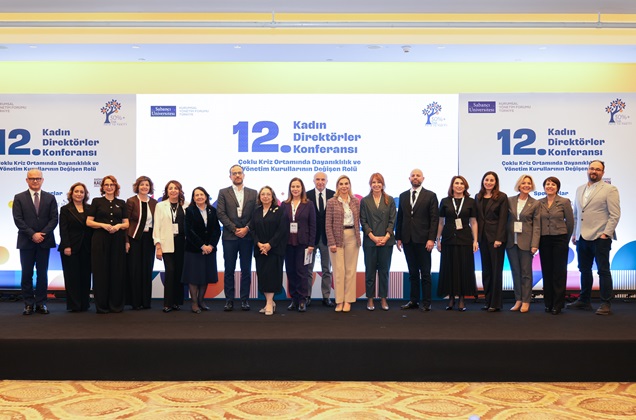
The 12th Women Directors Conference, organized by the 30% Club and hosted by the Sabancı University Corporate Governance Forum, took place on February 12th at The Marmara Taksim with the theme "Resilience in a Multiple Crisis Environment and the Changing Role of Boards of Directors." At the conference, the 12th edition of the "Women on Boards Türkiye" report, published annually by the Sabancı University Corporate Governance Forum since 2013, was shared with the public. According to the report, which examines the gender balance on the boards of directors of companies traded on the Istanbul Stock Exchange (BIST) and provides an annual assessment in terms of corporate governance, some progress has been made, albeit a small one, with the percentage of women on the boards of directors of BIST companies rising from 18.7% to 19.4% by 2025.
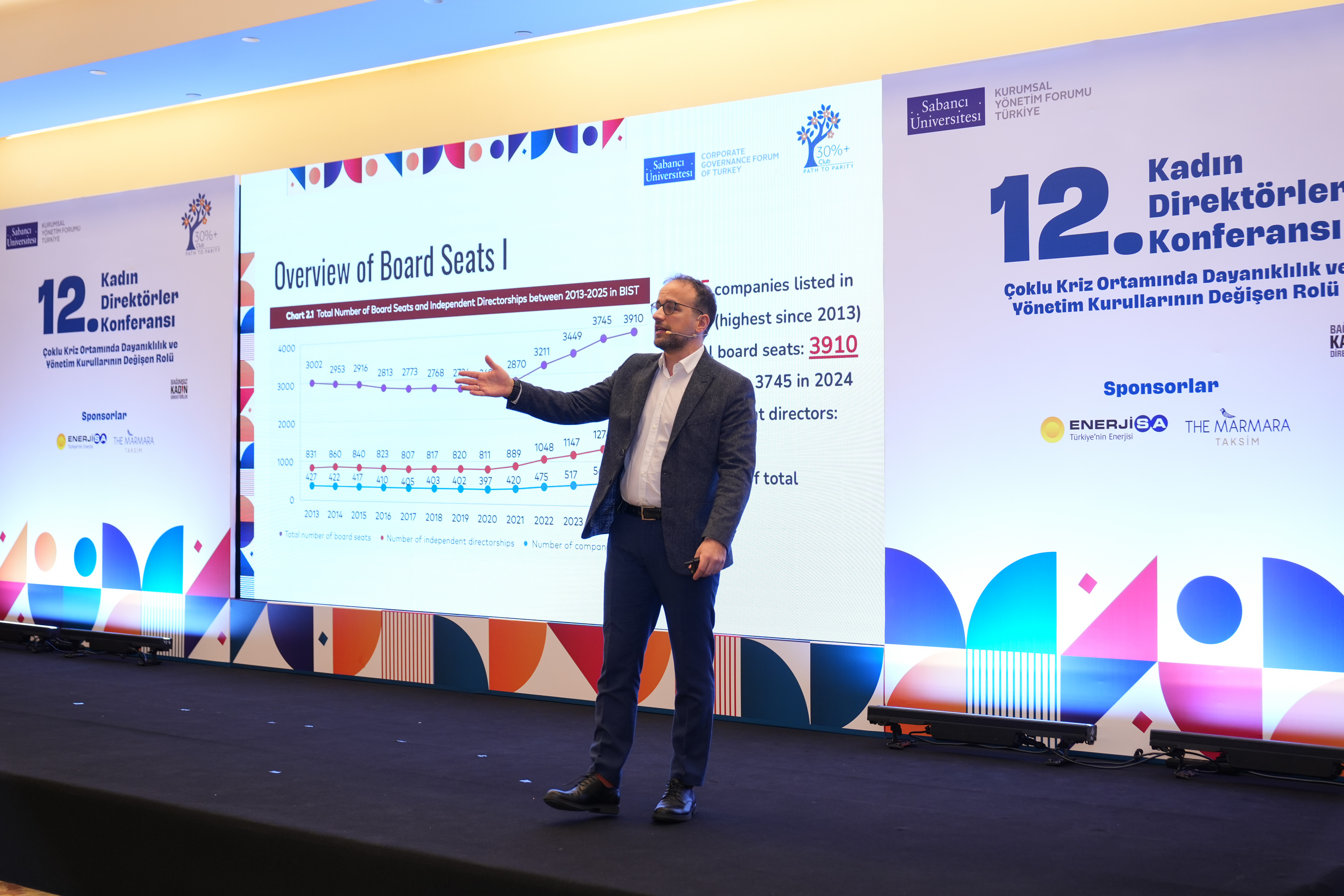
177 Companies Are Managed By Boards Composed Entirely Of Men
According to the 2025 data of the "Women on Boards Türkiye" report, presented by Ata Can Bertay, Faculty of Sabancı Business School Faculty Member, the percentage of women on the boards of directors of 394 BIST companies is below the 25% threshold. Although the number of companies that have reached the minimum 25% female board membership recommended by the Capital Markets Board (CMB) has increased from 183 to 191, this number constitutes only 32.6% of all companies. The report showed that 177 companies among all BIST companies, and 31 companies within the BIST-100, are still managed by all-male boards. While the number of companies with a female "Chair of the Board" increased from 50 to 57 among all BIST companies, the number of female "CEOs" on the boards of directors increased from 25 to 31.
The report also includes a projection of the number of new female board members that would be needed if quotas were implemented. According to this calculation, 177 new female board members are needed to ensure that BIST-listed companies have at least one female board member; if a 25% quota is applied, 433 new female board members are needed.
“Progress is Limited and Fragile”
In his assessment of the report, Ata Can Bertay stated, “Although the share of women on boards of directors reached its highest historical level at 19.4% in 2025, progress is still limited and fragile. There is a decline in the largest companies (BIST-100), and the number of boards of directors consisting entirely of men increased to 31. The fact that the rate of women in chairperson role remains at 9.7% and the rate of women in CEO role remains at 5.3% reveals the reality that there is representation, but it does not translate into power and executive floor. We should set the goal not as ‘symbolic’ representation, but as a transformation that strengthens the quality of decision-making, expands the pool of candidates, and makes appointment and nomination processes transparent, based on a critical mass, i.e., at least 30%. Even the requirement of at least one female director in 177 companies today is a concrete leverage that can, in a single step, accelerate the progress that the market would spread over years.”
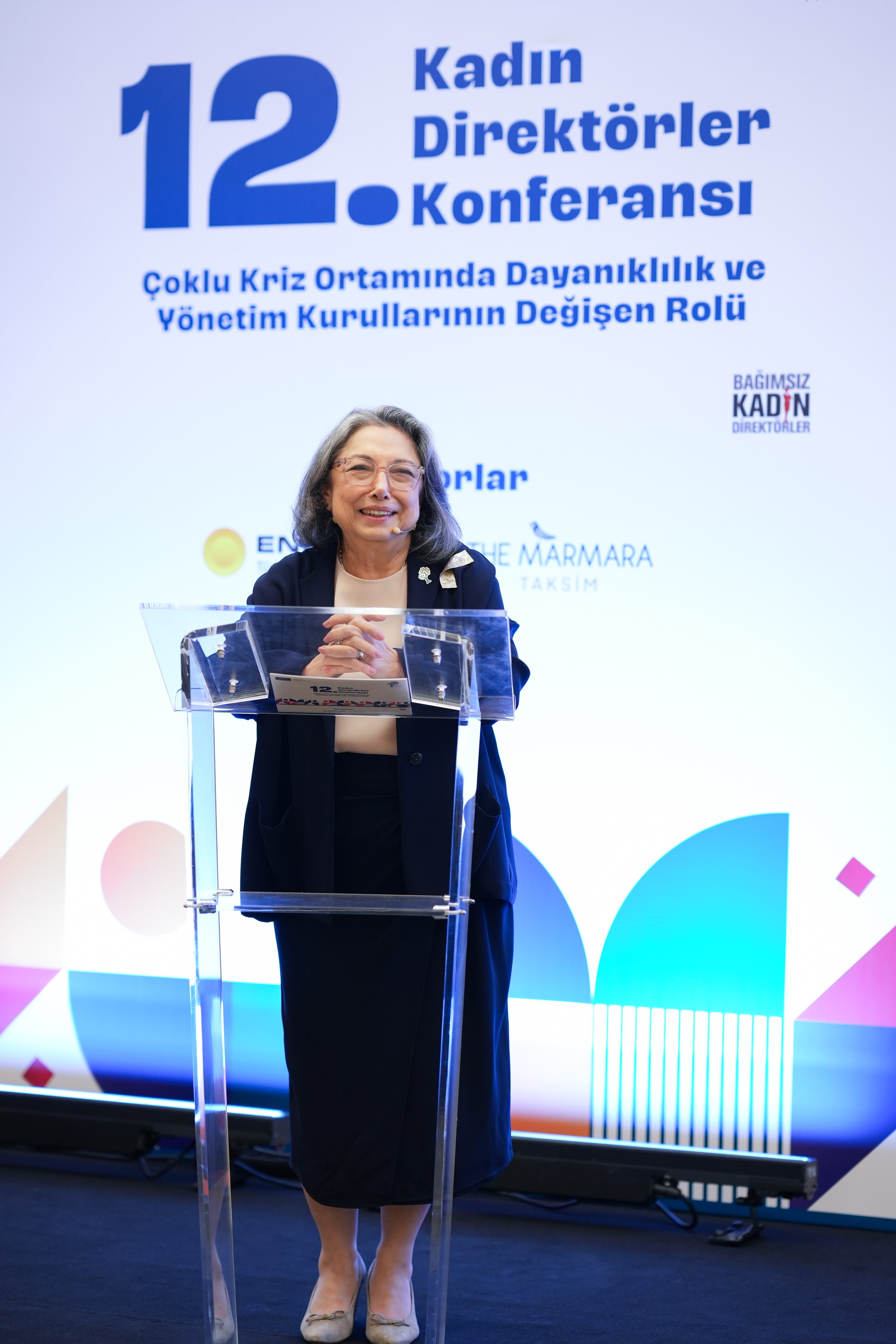
“Women represent a talent pool that can offer different perspectives to companies”
In her opening speech, Melsa Ararat, Chair of the 30% Club Türkiye, pointed out that managers will face problems in social and ethical areas that they have never encountered before in the coming period. Ararat stated, “It is necessary to be able to read geopolitical risks, closely follow developments in artificial intelligence and technology, foresee the dynamics between reshaping power centers and their impact on supply chains, and create a vision that takes into account all unpredictability, allowing for common sense. Women represent an untapped talent pool that can offer fresh and different perspectives to companies, independent of the traditions of male-dominated and entrenched boards. The most important step companies can take today is to review their boards of directors and create boards that reflect the realities of a highly unpredictable and multiple crisis environment. Effective, competent boards that encourage healthy discussions among different viewpoints, but can act decisively and swiftly based on shared values, can foster creativity and innovation by not allowing shortcuts that harm competition, applying zero tolerance for corruption, and creating work environments that respect freedom of expression and human rights.”
Women on Boards of Directors: A Strategic Necessity, Not a Preference
Ebru Taşçıoğlu, Head of Sustainability and Corporate Capabilities at Enerjisa Energy, emphasized, “Resilience in a multi-crisis environment is built not only with strong infrastructure or financial capacity, but also with robust governance structures and inclusive decision-making mechanisms. Women's representation on boards of directors is no longer a preference, but a strategic necessity. Different perspectives and cognitive diversity improve decision-making quality while strengthening the long-term value creation capacity of organizations. The current situation in Türkiye shows that voluntary efforts alone are not enough. This transformation needs to become a systematic, measurable, and widespread governance standard. Making diversity a sustainable and institutionalized governance practice is our shared responsibility.”
The Changing Responsibilities of Boards of Directors and Resilience were Discussed
Within the scope of the conference, a panel titled "The Increasing Strategic Role of Boards of Directors in a Multiple Crisis Environment," moderated by Dilek Bil, Independent Board Member of Aydem Renewable Energy, was held. Participants included Gözde Yalazı Özbek, Managing Partner & the Industrial Goods practice regional leader for Europe, the Middle East, South America, and Africa at BCG; Güven Özyurt, Leader of Ford Otosan; and Melis Ekmen Tabojer, Managing Director for Policy, Strategy, and Delivery at EBRD.
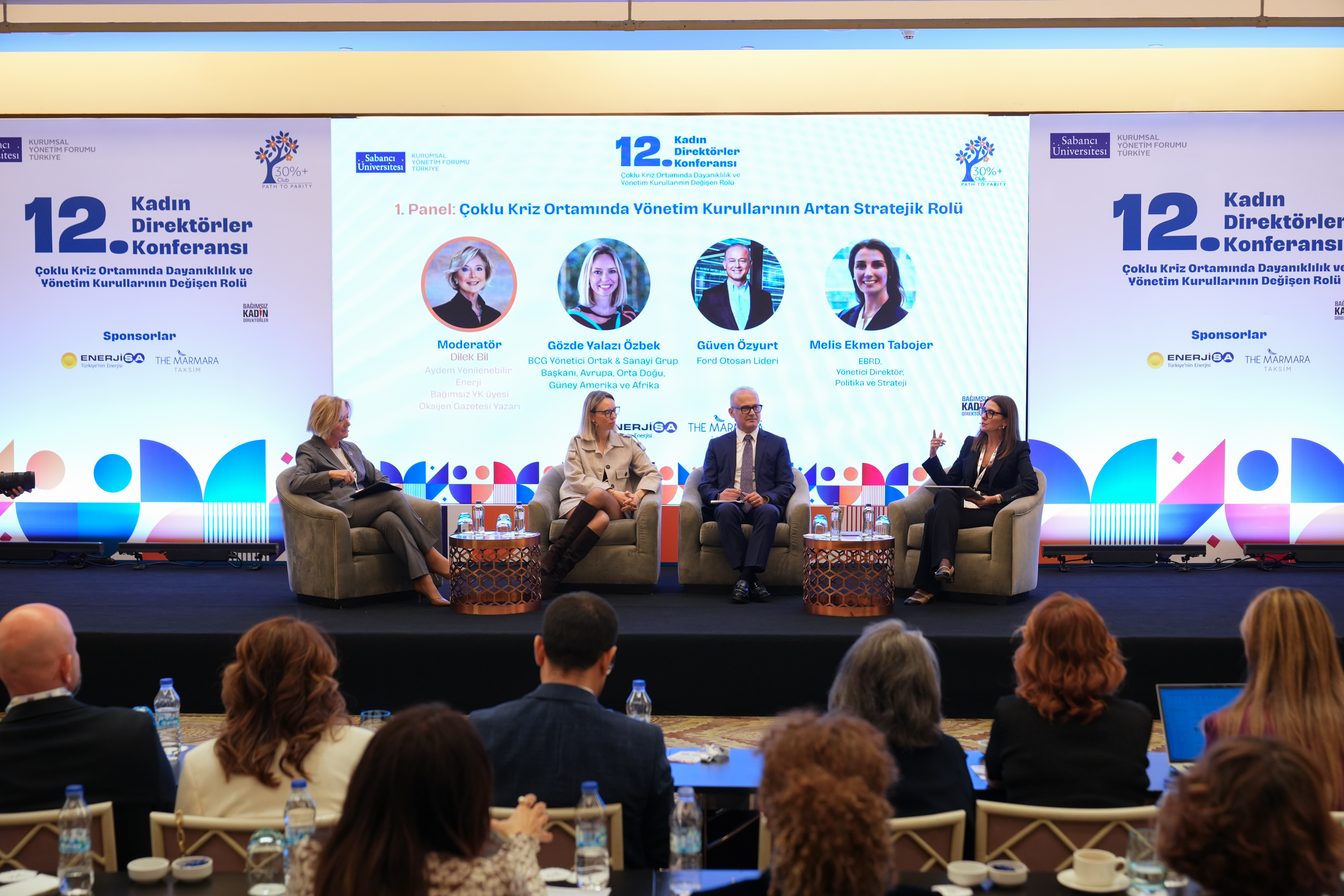
Dilek Bil, Independent Board Member of Aydem Renewable Energy, stated that in the era of multiple crises, boards of directors are no longer structures that merely oversee or approve strategy; rather, they are decision-making bodies that determine direction under uncertainty, assess risk appetite, and allocate capital. Dilek Bil stated, “What truly distinguishes boards is a governance architecture where diverse perspectives can be systematically incorporated into decision-making processes, healthy discussion is possible, and executive and strategic thinking are not detached. At this point, diversity ceases to be merely a matter of representation and transforms into an institutional capacity that enhances decision-making quality, reduces risk blindness, and expands the range of strategic options.”
BCG Managing Partner Gözde Yalazı Özbek pointed out that the strongest boards in the world are those that can transform different perspectives into genuine discussions in a global environment of uncertainty. Gözde Yalazı Özbek continued, “In Türkiye, we still frequently see examples where diversity exists but is not sufficiently reflected in decision-making processes. Multiple crisis situations are no longer an exception, and in this environment, diversity that can bring different perspectives into decision-making processes is more important than ever.”
Ford Otosan Leader Güven Özyurt stated, “In the shadow of multiple crises, the true strength of companies is no longer measured solely by financial statements; it is measured by their courage to bring together different perspectives and make long-term, inclusive, and human-centered decisions. At Ford Otosan, we take this approach not just as a principle, but place it at the heart of both our boards of directors and company management. Boards of directors and company managements that sincerely integrate diversity into decision-making processes, where women play an active role in strategic matters, produce more sensible, balanced, and promising results for the future during periods of uncertainty. In today's world, strong governance comes to life not by being confined to a single voice, but by the ability to transform different voices into collective wisdom.”
Melis Ekmen Tabojer, Managing Director for Policy, Strategy, and Delivery at the EBRD, stated: “At the EBRD, we view boards of directors as a key driver of corporate governance performance and resilience. The capacity to make decisions in uncertain environments, reputational risk management, innovation, diversity, and the integration of technology into governance form the foundation of financial success. In this sense, we encourage strong boards of directors that constantly adapt, constructively question governance, and align strategy with changing market realities. In today’s unpredictable world, we see board quality as a tangible investment variable that shapes long-term growth and investor confidence.”
Are Companies Ready for Change?
The panel titled “At the Threshold of Quotas: Are We Ready for Change?”, moderated by Korn Ferry Honorary Chair Şerif Kaynar, featured Polisan Holding Chair Tayfun Bayazıt, IFC Nominee Board Member Elif Ateş Özpak, and İnci Holding Nomination and Award Committee Chair & İnci Foundation Energy Source Ece Elbirlik Ürkmez.
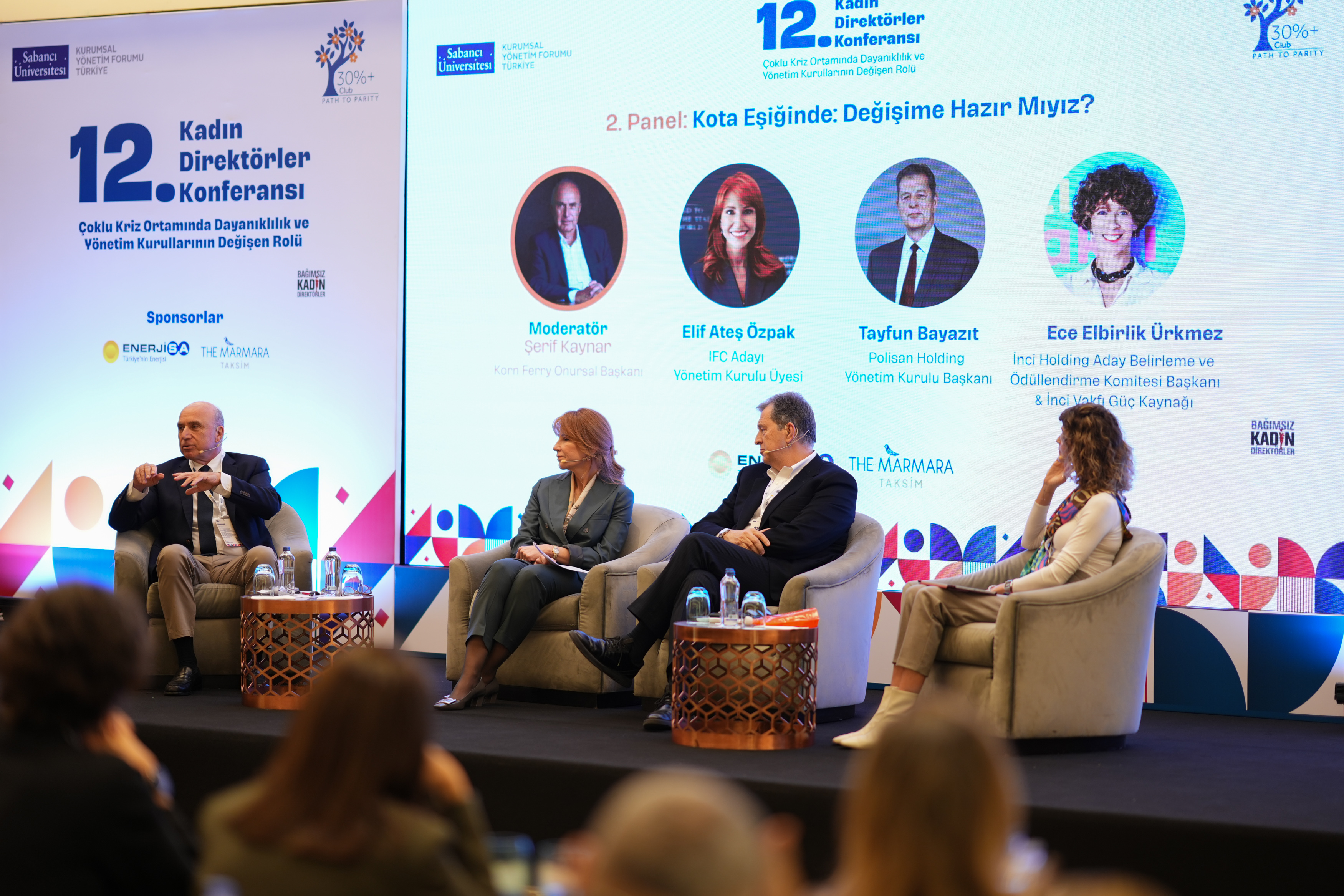
In his speech at the panel, Polisan Holding Chair Tayfun Bayazıt stated that the main issue is raising corporate governance standards and improving decision-making mechanisms. Bayazıt said, “We will have made a real breakthrough when we transform boards of directors from simple advisory bodies into structures that fully assume strategy, risk, and audit functions. The way to provide the rich perspective and experience that such competent boards need is to fully establish gender equality on boards of directors.”
IFC Nominee Board Member Elif Ateş Özpak said, “For international development finance institutions, diversity and women's representation on boards are not a statement of values or a declaration of intent. DFIs evaluate this issue through the effectiveness of corporate governance, how early and multifaceted risks are addressed, and whether decision-making processes are functioning properly. Therefore, from a DFI perspective, women's representation is seen as a concrete governance indicator of the company's long-term resilience and predictability.”
Ece Elbirlik Ürkmez, Head of the İnci Holding Nomination and Award Committee & İnci Foundation Energy Source, said that they can clearly see the impact of diversity on performance on boards. Emphasizing that complementary sets of experience, skills, and approaches form the basis for the sustainability of decisions made, Ece Elbirlik Ürkmez said, “If we are talking about representation, we should first discuss how to ensure equality in the conditions that bring individuals to these positions. While we strive to ensure this fairness within the institution through our company policies, we also run various programs on a societal scale through our foundation.”
A video message from Jennifer Barker, Global Chair of the 30% Club, was also shared with participants at the conference.
Companies supporting gender equality were rewarded.
At the 12th Women Directors Conference, the "Women-Empowered Boards of Directors" awards were also presented. This year, the conference, which recognizes companies that support gender equality in their boards of directors, awarded a total of 5 companies based on an evaluation using 2025 data.
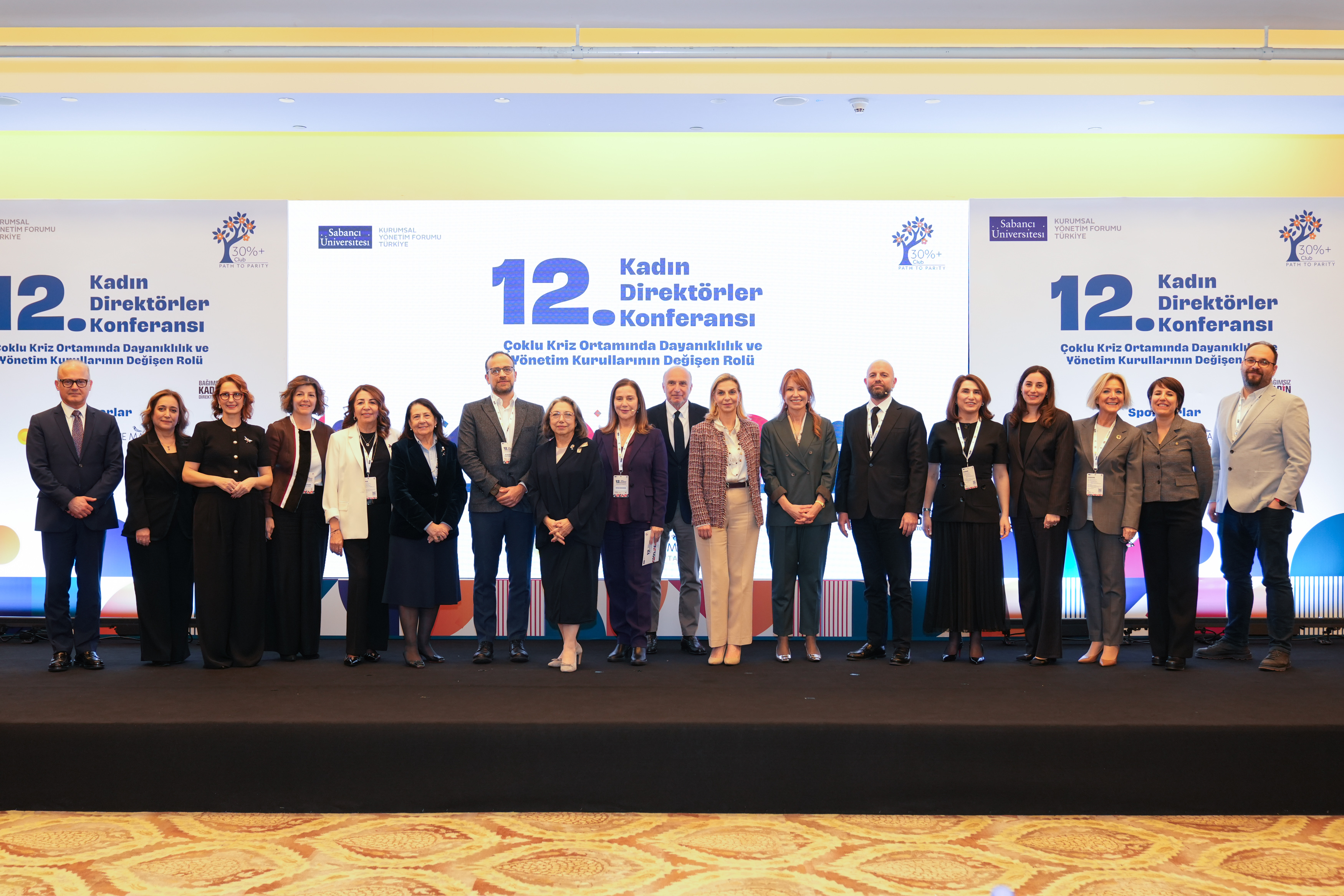
Award-Winning Companies:
● İş Bankası Group was awarded the "Women-Empowered Boards of Directors" award in the "Business Groups" category in 2025. İş Bankası Group earned this award because all of its group companies have female board members, it has companies with the highest value within the BIST 100 according to the Women-Empowered Boards of Directors Index, and İş Bankası, the top company of the group, gives significant roles to professional female directors on its Board of Directors.
● QNB Bank A.Ş. was awarded the "Women-Empowered Boards of Directors" award in the "Publicly Traded Banks" category in 2025. QNB Bank A.Ş. was awarded this prize because it has by far the highest female representation rate among publicly traded banks, with 4 female members on its Board of Directors.
● Enerjisa Enerji A.Ş. and Aksa Enerji A.Ş. shared the "Women-Empowered Boards of Directors" award in the "BIST 100 Energy Sector Companies" category in 2025. These two companies were awarded this prize for being the two energy sector companies in the BIST 100 index to have 3 female members on their Boards of Directors.
● Durukan Şekerleme A.Ş. was awarded the "Women-Empowered Boards of Directors" award in the "Companies with First-Time Public Offerings" category in 2025. Durukan Şekerleme received this award for having the highest number of female Board Members among companies in the same category.
You can access the "2025 Women on Boards Türkiye Report" here.