21/04/2026
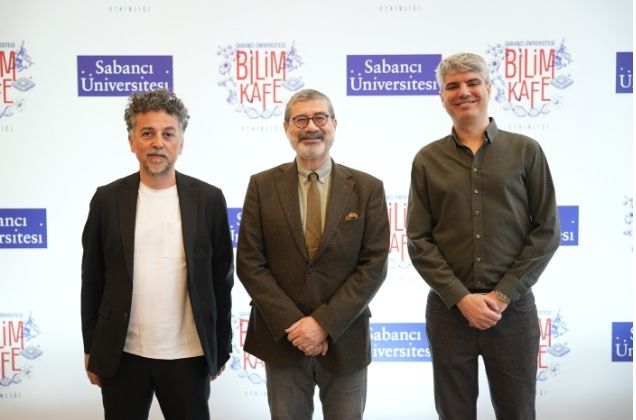
Sabancı University, as part of the “Science Cafe” events launched last year by the Council of Higher Education (YÖK), brought together faculty members and young people in Ankara. The Ankara Science Cafe event, which aims to encourage university and high school students to approach the world with scientific curiosity, critical thinking, and a desire for discovery, was attended by Sabancı University President Prof. Dr. Yusuf Leblebici, Sabancı University Faculty of Engineering and Natural Sciences faculty member Dr. İnanç Arın, and Sabancı University Faculty of Arts and Social Sciences faculty member Prof. Dr. Selçuk Artut. The event, which addressed the impact of current technologies on individuals and society from different perspectives, led participants on an interdisciplinary exploration centered on artificial intelligence, algorithms, and creativity.
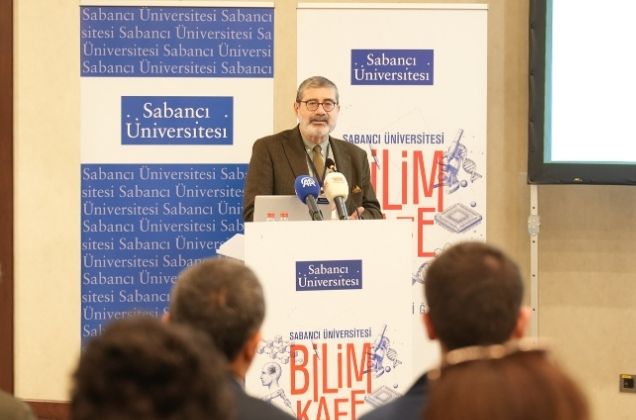
“Artificial intelligence is a multidisciplinary field with social, economic, and ethical dimensions.”
The opening of the event was made by Sabancı University President Prof. Dr. Yusuf Leblebici, who stated: “Although artificial intelligence seems like a new field in our lives, its foundations actually date back to 50-60 years ago. For many years, the biggest limiting factor in this field was the lack of access to sufficient data sets. However, in the last 10-15 years, especially with the digitalization and widespread adoption of mobile technologies, there has been a significant increase in data production, and existing algorithms have been revived, paving the way for the rapid development we see today. We are now in a multi-directional, not one-way, flow of information. Artificial intelligence has transformed into a multidisciplinary field with social, economic, and even ethical dimensions. We foresee that these developments will accelerate even further in the coming period, and we will encounter new approaches and applications almost every few months.” Professor Dr. Yusuf Leblebici, noting that the high processing power and energy requirements of artificial intelligence applications are also a significant agenda item, said, “Large data centers and processing infrastructures create significant energy consumption, and we need to think about the sustainability of this situation. Therefore, artificial intelligence represents a transformation that needs to be addressed together with different fields such as energy, economy, and sustainability. Young people will face many questions arising from artificial intelligence during this transformation process.”
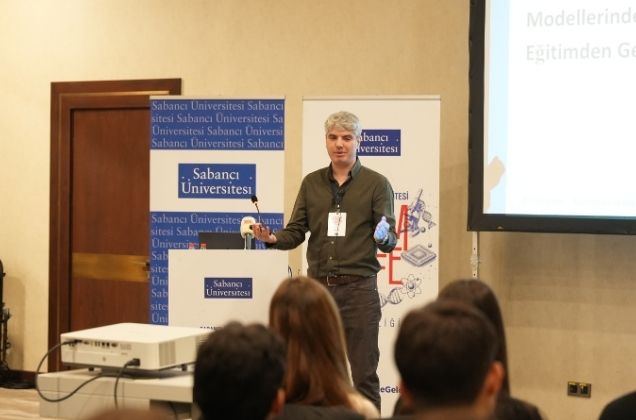
“Humans are becoming even more critical”
In his speech, Dr. İnanç Arın, a faculty member at Sabancı University's Faculty of Engineering and Natural Sciences, addressed the impact of artificial intelligence, machine learning, internet algorithms, and bots on daily life and the business world. Dr. İnanç Arın said, “Artificial intelligence is an extremely rapidly developing field, and therefore staying up-to-date is more important than ever. The fact that this technology reached 1 million users in just five days since its entry into our lives is an indicator of the kind of technology we are facing. The artificial intelligence revolution we are experiencing today was actually made possible by the realization of theories developed years ago, with the recent increase in data and processing power. This process now goes beyond individual productivity and points to a collective transformation where we discuss how teams and societies can work more efficiently together with artificial intelligence.” Emphasizing that the role of humans does not disappear with artificial intelligence, İnanç Arın stated, “On the contrary, humans are becoming even more critical. What matters is how we interpret, verify, and transform the output from artificial intelligence into real value. Therefore, it is necessary to approach artificial intelligence as a collaboration partner rather than a tool. This transformation we are experiencing is a change that we are shaping together. That's why it is of great importance not to give up on trying, questioning, and continuing to learn.”
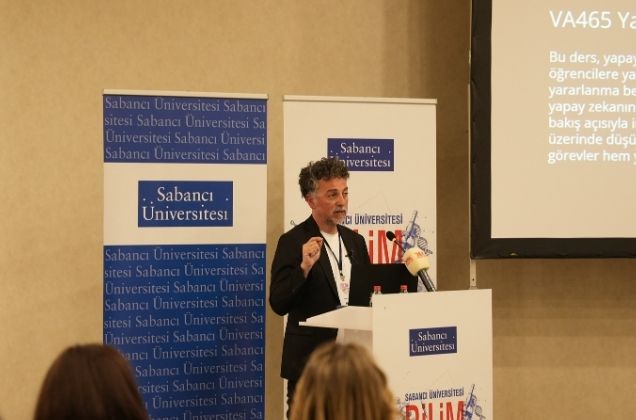
“Artificial intelligence is also transforming the way we perceive art”
Prof. Dr. Selçuk Artut, a faculty member at Sabancı University's Faculty of Arts and Social Sciences, evaluated the relationship between artificial intelligence and human creativity through artistic practices. Prof. Dr. Selçuk Artut said, “Artificial intelligence produces results based on powerful probabilities by feeding on large datasets. Therefore, we can talk about a productive structure. However, the question of how these productions should be evaluated as creativity continues to be debated. Artificial intelligence is transforming not only the tools used to create art but also the way we perceive art. Because artificial intelligence is involved, we fall into unconditional admiration. However, accepting something without emotion as artistic is merely a misconception caused by technological superiority. History will provide the answer to this. Many of these elements will not remain as cultural elements in the future.” Selçuk Artut, noting that artificial intelligence does not hinder creativity, said, “However, it shifts the focus from application to the curation of idea generation. It might be healthier to see artificial intelligence not as a creative 'subject,' but as a gigantic 'mirror' that triggers creativity. What we see in that mirror still depends on how we look at it.”
Aiming to spread scientific thinking
“Science Cafe,” one of the important initiatives of the Science Communication Office established by the Council of Higher Education (YÖK), stands out as a series of public events that directly connect academics with the public. This platform, where participants can ask experts questions directly, is an important science communication initiative aimed at increasing trust in science and spreading scientific thinking.