09/01/2026
Ersin Göğüş
Sabancı University Faculty of Engineering and Natural Sciences
Space has always been fascinating throughout human history because it is both mysterious and intriguing. For thousands of years, humans have questioned their own limitations when looking at the sky. In ancient times, people believed lunar and solar eclipses were divine messages from the gods. They determined the timing of necessary tasks for survival by looking at the stars. Today, we are watching the baby photos of the universe with the images obtained by the Hubble and James Webb space telescopes. With the human landing on the Moon, the rover exploration robots sent to Mars, or the first-ever imaging of a black hole, we have seen that places once considered "unreachable" are actually reachable. Space also keeps the question "Are we alone in the vast universe?" alive. This is why millions of people are excited when signs of life are found on an exoplanet or when an asteroid like 3I/ATLAS has recently passed near Earth. In short, space remains fascinating in every era, both because it serves as a bridge from mythological stories to modern science and because it constantly fuels human curiosity.
Planets orbiting stars outside our solar system are called exoplanets. Thousands have been discovered since the first exoplanet, discovered in 1995, which earned its discoverers the 2019 Nobel Prize in Physics. Some exoplanets are giants and very close to their central stars like Jupiter, while others are similar in size to Earth and located near the habitable zone. We discover most exoplanets through tiny dips in brightness or slight wobbles in their stars as they pass in front of them. The presence of biological markers of life, such as water vapor, methane, and carbon dioxide, in the atmospheres of some exoplanets leads us to consider them not just distant celestial bodies, but potential habitats, distant worlds.
We classify gas giant systems like Jupiter, which are very close to their central stars, as "hot Jupiter" exoplanets. Due to their large size, these planets are relatively easy to spot from afar and are therefore among the first to be discovered. Detailed studies of systems containing exoplanets can lead to the discovery of smaller planets within the same system. Just like our own system: an observer looking at the Solar System from very far away through a telescope would naturally first discover Jupiter because its surface area is 120 times that of Earth, and its mass is more than 300 times that of Earth.
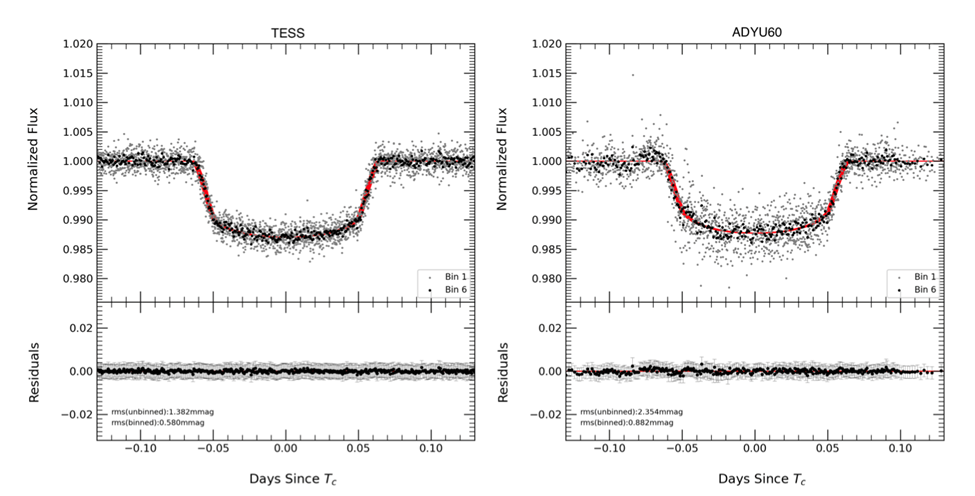
In a study we conducted last year, we observed three "hot Jupiter" exoplanets, HAT-P-16b, TOI-1516b, and TOI-2046b, during their transits across their stars using both NASA's Transiting Exoplanet Survey Telescope (TESS) and ground-based telescopes in our country. We investigated transit timing variations that can occur when exoplanets pass in front of their stars. As a result, we found a significant variation in TOI-1516b; we concluded that this is an indication of the gravitational influence of another celestial body (possibly an exoplanet) in the system or an orbital change. We obtained a weaker indication in HAT-P-16b, but we will continue our investigations with more observations to draw definitive conclusions. In TOI-2046b, we did not find any statistically significant variation in the observed times. Such studies are of great importance for our better understanding of the characteristics of exoplanet-containing systems and for identifying other celestial bodies, if any, orbiting the central star.