10/02/2026
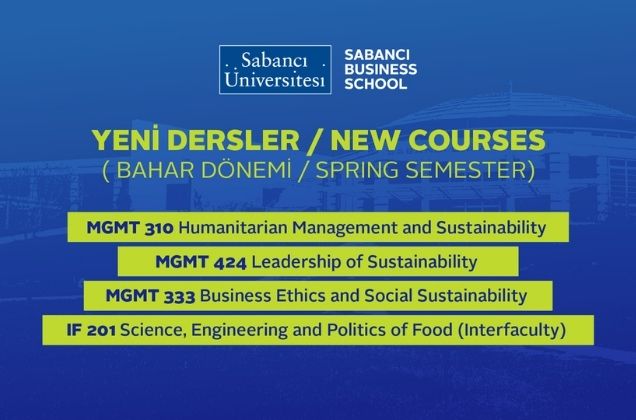
New courses from Sabancı Business School bring students together with the world's most current issues in the same classroom during the spring semester. Courses ranging from the economics of humanitarian aid to sustainability leadership, from the science of food systems to ethical decisions in the business world, offer a powerful learning environment for students who want to understand, question, and produce solutions to global problems. With content that blends theory and real life, the courses address issues that are relevant both on and off campus.
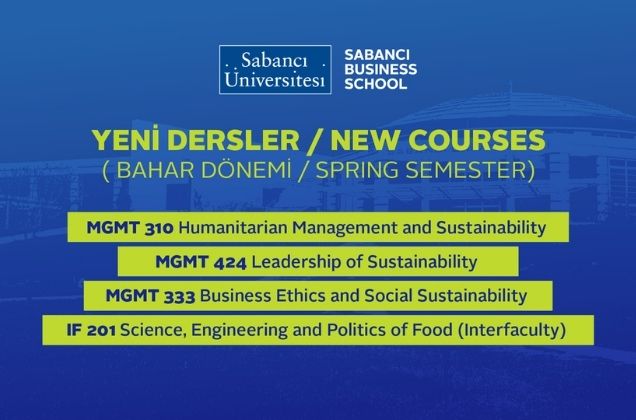
The newly opened courses MGMT 310 – Humanitarian Management and Sustainability, MGMT 424 – Leadership of Sustainability, and MGMT 333 – Business Ethics and Social Sustainability, offered within the scope of the Sustainability Minor Program, aim to provide students with a multi-dimensional, sustainability-focused perspective in the spring semester.
Three New Courses in the Sustainability Minor Program
1. The Economics and Politics of Humanitarian Aid Examined
MGMT 310 – Humanitarian Management and Sustainability examines humanitarian aid not only within the framework of philanthropy and emergency relief, but also as a global industry shaped by money, power, and politics. In this course, taught by Dr. Asma Hedi Nairi, students will have the opportunity to critically examine the sources of humanitarian aid funds, how these funds are organized, and how they are experienced in the field.
The course, which will discuss questions such as "Who benefits from humanitarian aid?", "Are cash donations truly empowering?", and "Is a more equitable, locally-led humanitarian aid system possible?", offers a strong perspective, especially for students considering careers in international organizations, civil society, and public policy. Case studies from Türkiye, the MENA region, Europe, and Africa are also important components of the course.
Classroom: FENS L062 (Wednesday), FENS G029 (Friday)
2. Sustainability Treated as a Matter of Leadership
MGMT 424 – Leadership of Sustainability examines sustainability as a leadership matter through the daily decisions, trade-offs, and power dynamics within organizations. The course, led by Prof. Dr. Itır Göğüş, includes interactive discussions, real-life cases, simulations, and applied team projects.
Instead of teaching sustainability as a “checklist,” the course focuses on the dilemmas and uncertainties managers face when trying to create meaningful and lasting change. Thus, students have the opportunity to learn by experiencing how sustainability transformation is managed in practice.
Classroom: SBS G060
3. Business Ethics and Social Sustainability
MGMT 333 – Business Ethics and Social Sustainability focuses on ethical decision-making processes in the business world. Taught by Dr. Öykü Arkan Tunç, the course starts with the question of how managers should act when ethical principles conflict with business goals.
The responsibilities of companies towards employees, communities, and society; issues such as inequality, human rights, and the importance of sustainability for careers form the main discussion areas of the course. How to make ethical decisions in a global and uncertain world is also at the heart of the course.
With these four new courses to be offered in the spring semester, the university aims to equip students not only with professional knowledge but also with an ethical, sustainable, and socially responsible perspective. The courses to be offered in the spring semester once again demonstrate the university's interdisciplinary educational approach promoting critical thinking.
Classroom: FASS 1097
A Brand-New Course Through Sabancı Business School Coordination and Inter-Faculty Collaboration
In the spring semester, the inter-faculty course IF 201 – Science, Engineering and Politics of Food, implemented at the suggestion of Sabancı University Vice President for Education Cem Güneri and coordinated by Prof. Dr. Zafer Yenal, is also among the new courses.
Science, Engineering and Politics of Food
The IF 201 – Science, Engineering and Politics of Food course addresses how food, agriculture, technology and politics shape each other with an interdisciplinary approach. Coordinated by Prof. Dr. Zafer Yenal, the course also includes contributions from academics from different fields.
The content, ranging from fermentation to seed policies, from soil health to circular design, opens up discussions on the biological, historical and political dimensions of food systems. Supported by applied experiments and group projects, students can benefit from the resources of the Culinary Arts Academy and the guidance of chef instructors if they wish to develop their projects. No science or engineering background is required to participate in the course; curiosity and interest are deemed sufficient. The course teaching staff includes Prof. Dr. Zafer Yenal, as well as Prof. Dr. Burcu Saner Okan, Dr. Emre Erol, Prof. Dr. Levent Öztürk, Dr. Nihal Öztolan Erol, Assoc. Prof. Ogün Adebali, and Prof. Dr. Zafer Gedik.
Classrooms: FASS G025 (Tuesday), FASS G022 (Thursday)