18/02/2026
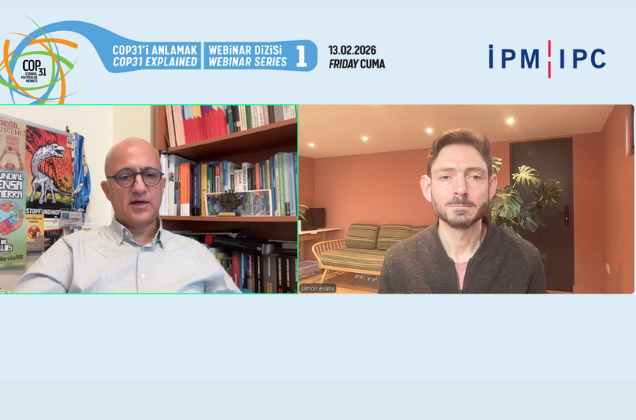
The first event in the "COP31 Explained" webinar series, which will continue throughout the year as part of the Istanbul Policy Center's (IPC) preparations for COP31, was held on February 13th. The first event addressed the functioning of international climate negotiations and current debates ahead of COP31, which will be hosted by Türkiye in Antalya. The event, moderated by Ümit Şahin, Coordinator of the IPC Climate Change Studies, featured Simon Evans, senior policy editor and journalist at Carbon Brief, who has followed climate negotiations for many years.
What is COP, How Does it Work?
In the first part of the webinar, Ümit Şahin presented the historical background of the COP processes under the United Nations Framework Convention on Climate Change (UNFCCC). It was noted that the international climate regime, which took shape starting from the 1972 Stockholm Conference and the 1992 Rio Summit, is today one of the most widely participated global agreements, with 198 countries and the EU as parties.
Şahin stated that three separate Conferences of Parties (COP, CMP, CMA) run parallel during the COP meetings; negotiating topics such as mitigation, adaptation, loss and damage, financing, and emissions trading. The fundamental characteristic of the process is that decisions are made by consensus, not by majority vote. Because no agreement could be reached on voting procedures in the rules adopted in 1995, all COP decisions are based on the common agreement of the parties.
It was emphasized that the Paris Agreement introduced a "bottom-up" structure where countries submit their own national contributions; and that the target of limiting the temperature increase to 1.5°C was confirmed in Glasgow in 2021.
Paris Agreement: Success or Failure?
As the 10th anniversary of the Paris Agreement passed, one of the key topics of the webinar was its balance sheet. Simon Evans stated that the fact that global emissions are still increasing strengthens the criticisms; however, compared to the projections from 10 years ago, it is seen that the world is moving towards a warming path of approximately 2.5°C instead of 3-4°C.
According to Evans, there are two possible interpretations when evaluating the Paris Agreement: optimistic and pessimistic. Although the continued record-breaking emissions reinforce the negative picture, the fact that the multilateral system has largely remained intact and countries have maintained their commitment to the process stands out as an important achievement.
“Successful COP” According to Whom?
The question of whether a COP is considered successful is not dependent on a single criterion. Evans emphasized that success varies according to the priorities of the countries. Each COP is remembered for a specific decision or theme: Glasgow for the phasing-out of coal, Sharm El Sheikh for the establishment of a loss and damage fund, and Dubai for making that fund operational and expressing a commitment to moving away from fossil fuels.
The COP31 agenda is expected to focus on trade measures, finalizing the technical details of the Global Goal on Adaptation, and discussions on the fossil fuel roadmap.
Transparency and Presidential Debates
One of the most notable sections of the webinar was the issue of transparency in debates. The increase in "presidential debates" in recent years and the conduct of critical discussions in presidential offices instead of official meeting rooms has been criticized.
Evans stated that the role of the presidency is essentially to facilitate the decisions of member states; however, conducting the process behind closed doors can lead to trust issues. It was noted that especially when the limits of the consensus principle are pushed, undermining trust between the parties makes the negotiation process more difficult.
The message emphasized that a transparent, inclusive, and trust-building presidential approach will be crucial for COP31, which will be hosted by Türkiye.
Ways to Follow COP
Evans also reminded participants that COP processes are not limited to negotiation rooms; the Blue Zone and Green Zone distinction, country pavilions, and civil society events are also part of the process. It was also highlighted that resources such as the Earth Negotiations Bulletin, Third World Network, and Carbon Brief offer important tools for monitoring negotiations.
The webinar series organized by IPC in preparation for COP31 will continue in the coming months with different topics. The series will cover a variety of subjects ranging from the technical aspects of negotiations to the action agenda, and from financing to transparency discussions.