

11/02/2026
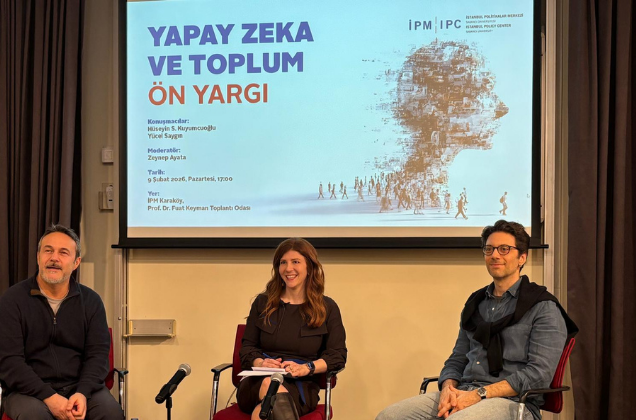
The ‘Artificial Intelligence and Society’ talks series, which addresses the multifaceted social impacts of artificial intelligence, began at Sabancı University with its first event titled ‘Prejudice.’ In the opening session of the series, the areas where artificial intelligence intersects with daily life were discussed in terms of ethics, justice, economics, and social inequalities.
Hüseyin S. Kuyumcuoğlu and Yücel Saygın from Sabancı University participated as speakers in the event held on Monday, January 12, 2026. Zeynep Ayata moderated the session. In the seminar, the relationship between artificial intelligence technologies and society was discussed in terms of prejudice, representation, and ethics. The speakers emphasized that algorithmic systems are shaped not only within a technical context but also within a social and cultural context.
The speakers stressed that artificial intelligence is not just a technology but a system that feeds on human experience and is intertwined with social structures. Training models with human-generated data necessitates a rethinking of widely accepted assumptions about the neutrality of technology. In this context, ways to build fairer and more balanced systems were discussed, drawing on examples of how some algorithmic systems used in the past have generated bias in recruitment, credit evaluation, or judicial decision support mechanisms.
Transparent, Understandable, and Human-Centered Systems
One of the prominent themes of the event was the need to make the decision-making process of artificial intelligence systems more understandable and transparent. Participants pointed out that hybrid models, in which humans remain involved in the process, could produce more sensible results, rather than technology transforming into a fully automated authority.
This approach was taken with the goal of transforming artificial intelligence from a "black box" into a tool that has social responsibility. It was emphasized that advancing technical developments alongside ethical frameworks could pave the way for more reliable and inclusive applications.
Data, Representation, and a Fairer Future
During the Q&A session of the event, the issue of data representation, particularly in the health sector, came to the forefront. Participants stated that incorporating data from vulnerable groups into AI systems in a more balanced, secure, and ethical manner offers a significant opportunity to develop more sensitive, fair, and unbiased applications.
In this context, it was emphasized that increasing data diversity is not only a technical issue but also a step that strengthens social inclusion. It was noted that AI, when designed correctly, has the potential to make different social experiences more visible and representative.
The Series Will Continue
The "Artificial Intelligence and Society" seminar series will continue with new events held every month. In upcoming meetings, different themes such as social risks, opportunities, inequalities, labor market transformation, privacy, and human rights will be discussed through the lens of artificial intelligence. The series aims to evaluate the possibilities offered by artificial intelligence while also discussing solutions to prevent social harms.


